REVIEW · HONOLULU
Battleships of WWII at Pearl Harbor from Maui
Book on Viator →Operated by Aloha Sunshine Tours · Bookable on Viator
Pearl Harbor has a way of getting under your skin. This Maui-to-Oʻahu day trip takes you from the quiet USS Arizona Memorial to the deck of the USS Missouri—then continues on to Honolulu’s royal-era highlights. I especially like the Navy boat crossing and the chance to see the wreckage from the USS Arizona Memorial, plus the guided walkthrough on Battleship Missouri that brings the end of WWII into focus. Just know this isn’t a casual sightseeing day; it’s heavy on walking and the memorial moments call for respectful silence.
The big drawback is simple: time. The day moves from site to site for about 7 to 9 hours, and if you want extra museum time, this isn’t that version. Also, you’ll be dealing with Pearl Harbor bag rules—no purses or bags inside, with storage available for $7—so plan light and keep things easy.
In This Review
- Key things I’d mark on your map
- From Maui to Pearl Harbor: why the early start matters
- Pearl Harbor Visitor Center: start with context, not just photos
- USS Arizona Memorial: quiet, wreck views, and The Tears of the Arizona
- USS Missouri Memorial: the deck tour that explains the surrender moment
- USS Oklahoma Memorial: a second tragedy, different setting
- Honolulu city time: history narration beyond Pearl Harbor
- Punchbowl Crater (National Memorial Cemetery) and the views over Oʻahu
- Iolani Palace and the monarchy story you can actually see
- Price and value: is $459.99 a fair deal?
- Practical tips that make the day smoother
- Should you book this WWII and Honolulu history day trip?
- FAQ
- What’s the total duration of the tour?
- What’s included in the price?
- Are meals included?
- Do I need to pay for admission tickets?
- Where do you pick up passengers in Honolulu?
- Can I bring a bag or purse into Pearl Harbor?
- Is the tour too much walking?
Key things I’d mark on your map
- Round-trip airfare from Maui is included, so you’re not renting a car or piecing together flights
- USS Arizona Memorial includes the boat ride and wreck-viewing, with time to read the names at the remembrance wall
- The Battleship Missouri deck tour is guided, covering officer and crew areas, artillery, and the surrender moment
- USS Oklahoma is a land-based memorial, with more casualties from Dec. 7, 1941
- Punchbowl Crater gives big-city views over Honolulu while you’re in a place built for remembrance
- You’ll mix WWII with Hawaiian monarchy sites, including Iolani Palace and Kawaiahaʻo Church
From Maui to Pearl Harbor: why the early start matters
This is a full-day operation that begins fast. The start time is 7:00 am, and the day is built around getting you into Pearl Harbor with enough time to experience the memorials and still reach downtown Honolulu stops.
What I like about the format is that it handles the most annoying parts for you. Round-trip flights from Kahului Airport (Maui) to Honolulu International Airport are included. You also get pickup from the airport depending on the airline terminal and then an organized route into Pearl Harbor.
Also, your group size is capped at 24 travelers. That usually means fewer delays than big-coach chaos, and it helps when you’re timed around boats, lines, and the kind of solemn pacing that memorial sites require.
If you’re the type who needs a long, unstructured lunch break to enjoy a day, you’ll want to adjust expectations. This is more “focused and efficient” than “slow travel.”
You can also read our reviews of more tours and experiences in Honolulu.


Pearl Harbor Visitor Center: start with context, not just photos
Your first stop is the Pearl Harbor Historic Sites Visitor Center. This matters because it sets the stage before you step onto the memorials.
Inside, you can work through exhibits that explain the events leading up to the attack on December 7, 1941. Then you’ll watch a 23-minute documentary that frames what happened, why the USS Arizona Memorial is significant, and how the attack changed the course of WWII.
The value here is that it saves you from trying to understand everything on the fly while standing in front of artifacts and remains. Even if you think you already know the broad strokes, that film helps you connect dates, ships, and places.
After the exhibits and film, you head to the water. You board a U.S. Navy-operated boat for a short ride across the harbor—listed as a calm 10-minute crossing—with views of the surrounding military installations. This is one of those moments that feels “brief” but actually changes the tone of the day. You’re not just arriving; you’re moving into the history.
USS Arizona Memorial: quiet, wreck views, and The Tears of the Arizona
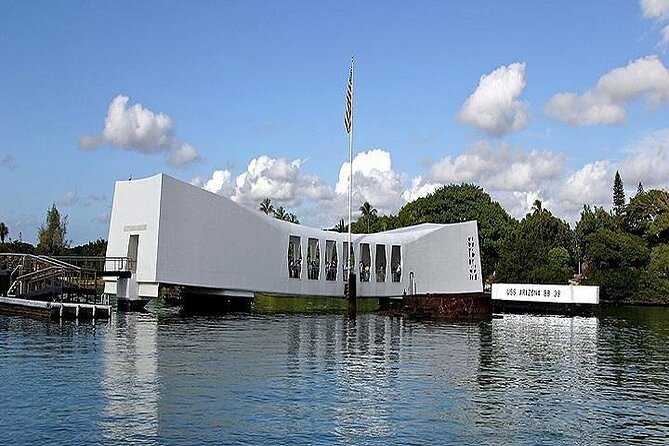
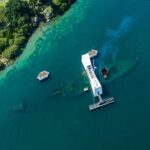
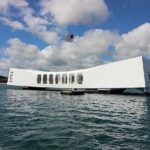
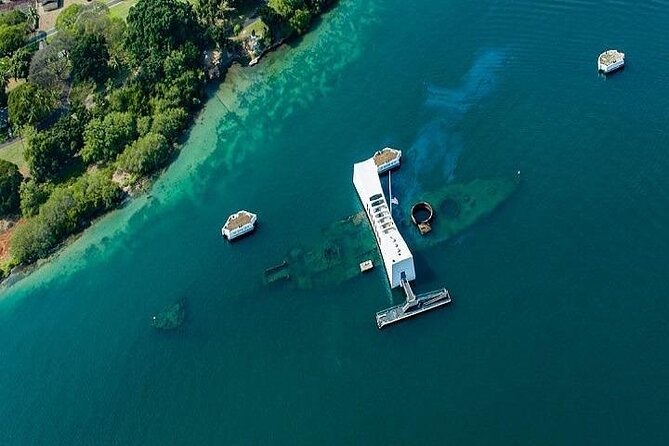
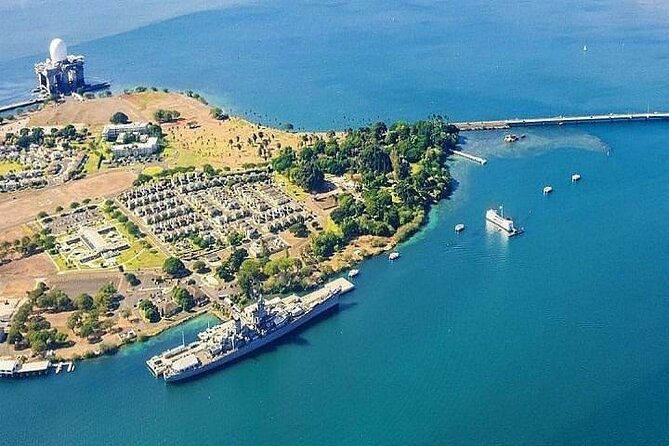
Then comes the part most people remember hardest: the USS Arizona Memorial. It’s a white, open-air structure spanning the remains of the sunken battleship. The atmosphere is designed for reflection, and you’ll feel that immediately.
You can look down into the water from inside the memorial. The ship’s outline is visible just below the surface, and oil droplets are sometimes seen rising—often referred to as The Tears of the Arizona. That detail is haunting because it’s not a reenactment. It’s an ongoing physical reminder.
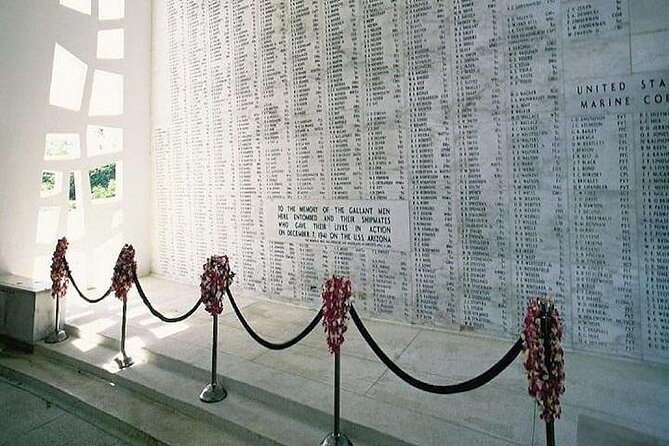
At the far end, there’s the remembrance wall, inscribed with the names of 1,177 crew members who lost their lives aboard the USS Arizona. Even if you only read a few names, the wall gives the experience a human scale. It’s not “history class.” It’s names, people, and loss.
Your time at this stop is listed as about 1 hour with admission included. That’s usually enough to absorb the wreck-viewing moment and walk the memorial space without feeling rushed. Still, this is not the place for multitasking. If you want to take pictures, do it thoughtfully. And if you’re sensitive to heavy scenes, give yourself a minute before stepping inside.
One practical note: the tour encourages respectful silence during the USS Arizona portion. It’s not just etiquette—it’s part of why the memorial hits so hard.
USS Missouri Memorial: the deck tour that explains the surrender moment
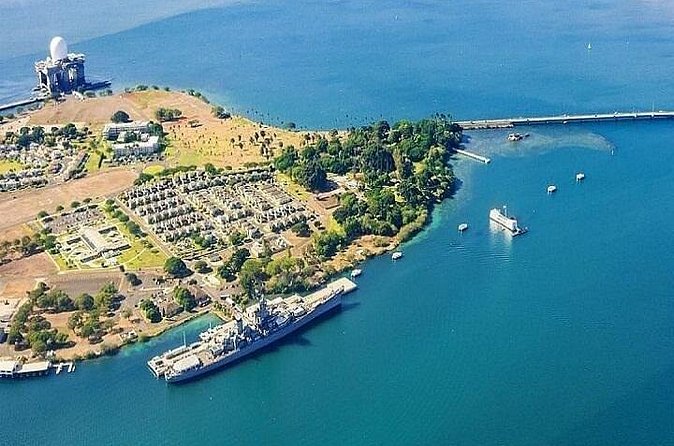
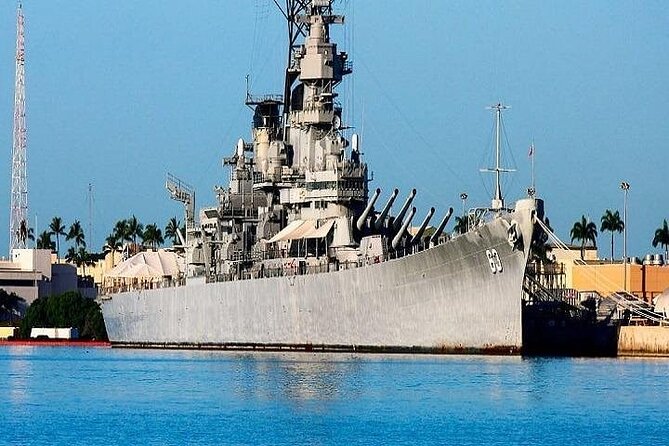
Next up is the Battleship Missouri Memorial, described as the last battleship the U.S. ever built. This stop is one of the day’s strongest “guided learning” pieces because you’re not only looking at the ship—you’re walking through story.
You’ll walk the deck in the footprints of General MacArthur and Admiral Chester Nimitz. That detail helps you understand how the ship became a stage for WWII’s final chapter.
The guided deck tour includes several specific elements:
- officer and crew quarters
- artillery placements
- a kamikaze aircraft crash site (as part of the ship’s WWII record)
- the surrender ceremony context tied to 1945
That mix is important. Pearl Harbor has one kind of emotional weight. The Missouri adds another: how the war ended, and how command decisions turned into a historic public surrender event.
You’ll spend about 2 hours here, with USS Battleship Missouri admission included. The longer stop length compared to other memorials makes sense: the deck is large, and the guide’s narration helps you connect what you’re seeing to why it mattered.
If you want a “less solemn, more explanatory” moment after Arizona, this is it. It still respects the past, but it’s more about how WWII unfolded into its endgame.
USS Oklahoma Memorial: a second tragedy, different setting
From there, you shift to the USS Oklahoma Memorial, a land-based memorial at Pearl Harbor. This ship is described as having more than 400 servicemen who were killed during the flurry of attacks on Dec. 7, 1941—second only in casualties to the USS Arizona.
This stop is about 2 hours with admission included. The difference in setting matters. Arizona is ocean-facing and built around a visible wreck context. Oklahoma is commemorative on land, and the experience tends to feel more like a structured remembrance space than an underwater viewpoint.
I like pairing Arizona and Oklahoma back-to-back. It keeps the day from turning into a single emotional highlight. Instead, it shows you the scale of loss across multiple ships and locations that day.


Honolulu city time: history narration beyond Pearl Harbor
The Pearl Harbor portion is only part of the experience. After the memorials, you head to downtown Honolulu for a guided historic-city narration.
This segment is listed as about 45 minutes and includes a mix of Hawaii’s history, cultural heritage, and modern city life, told by your expert guide. This is a smart pacing choice. You get a change of scenery, but you’re still staying in “story mode,” not “random wandering.”
Then you get more of the Honolulu historic core through a sequence of stops connected to the Hawaiian Kingdom and important remembrance spaces.
Punchbowl Crater (National Memorial Cemetery) and the views over Oʻahu
One of the most moving places on the route is the National Memorial Cemetery of the Pacific, built on Punchbowl—an extinct volcanic crater.
You’ll see neatly maintained grounds with rows of white headstones against lush greenery. The location is more than scenic. It’s part of why it lands emotionally: you’re looking down and outward from a place designed for honoring thousands of U.S. military members.
And the crater top gives stunning views over the surrounding city: you can see downtown Honolulu, Diamond Head, and the coastline depending on conditions.
This stop is a good example of why the tour isn’t only about WWII mechanics. It uses place—terrain, visibility, and design—to connect military history to the geography of Oʻahu.
Iolani Palace and the monarchy story you can actually see
After Punchbowl, you move into royal-era Honolulu.
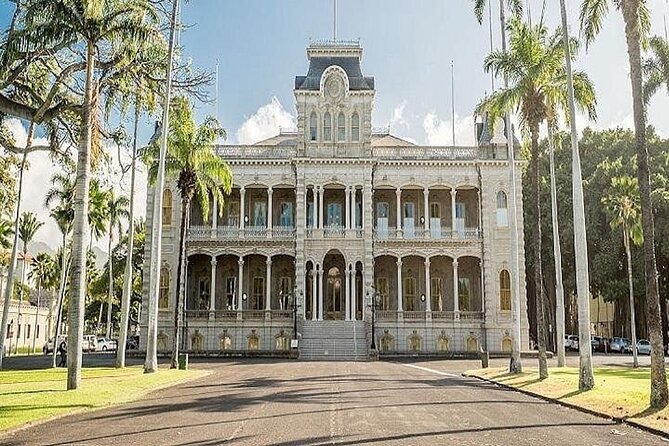
You’ll visit Iolani Palace, noted as the only royal palace in the United States. Here, you learn about Hawaii’s monarchy and hear stories connected to King Kalākaua and Queen Liliʻuokalani, the last reigning monarchs. Admission is listed as free, and the time is about 15 minutes.
That time window is short, so I’d treat it like orientation. You’re there to understand the role of the palace in the Kingdom story, not to do an hour-long museum crawl.
From there, you’ll also view:
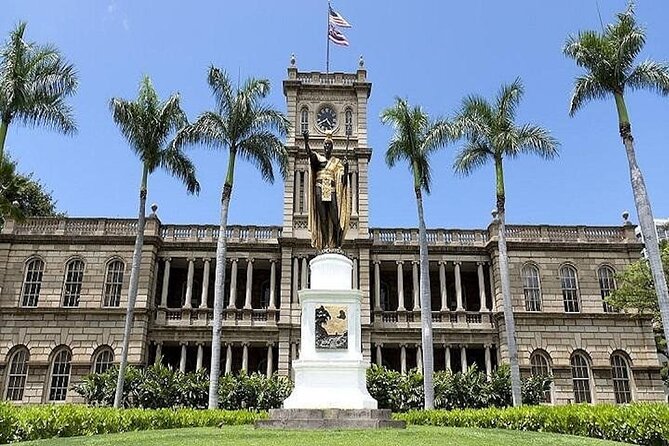
- the King Kamehameha Statue, linked to Hawaii’s unity symbol
- Aliʻiōlani Hale, the historic building that now houses the Hawaii State Supreme Court
Your guide also does talk story related to the original government building of the Hawaiian Kingdom. It’s a good way to keep the palace from feeling like a cold monument.
Then there’s a stop for Kawaiahaʻo Church, often referred to as the Westminster Abbey of the Pacific. Your guide will explain its significance and role in Hawaii’s religious history. Even if you don’t spend long inside (time isn’t specified beyond learning), the context helps you notice why it’s considered one of the key historic sites in town.
Price and value: is $459.99 a fair deal?
The price is $459.99 per person, and it can sound steep until you break down what’s included.
Here’s the big value lever: round-trip airfare from Maui to Honolulu is included. Many Pearl Harbor visits are expensive because they require you to manage flights, rental cars, or separate admission add-ons. This one wraps airfare into the package, which is a win for convenience and predictable budgeting.
You also get:
- Arizona Memorial boat admission included
- USS Arizona Memorial admission included
- Battleship Missouri admission included
- shuttle service from Pearl Harbor Visitor Center to USS Missouri Memorial included
- an air-conditioned vehicle
- guided narration across both WWII sites and the Honolulu historic stops
- admission tickets provided by your guide on the day of your tour
What you pay separately for is mostly what you’d expect:
- meals are at your own expense
- parking fees are at your own expense
- transportation to Kahului Airport isn’t included
- you’ll need to handle baggage storage rules at Pearl Harbor
I’d call this good value if you want a guided, low-friction way to do Pearl Harbor plus a handful of big Honolulu landmarks in the same day. If you’d rather go slow and spend hours in museums, then it may feel like a lot of structure for the money.
Also note the tour is specifically described as not including visits to museums. If you’re the type who wants to linger in exhibit halls and archives, look for a more museum-forward option.
Practical tips that make the day smoother
This kind of day trip rewards good prep.
Wear comfortable shoes. You’ll be walking across multiple stops, including deck walking on a battleship and campus-style grounds at memorial sites. The tour isn’t recommended for people who can’t walk about four city blocks.
Pack light for Pearl Harbor. Purses and bags are not allowed inside Pearl Harbor. You can store bags for $7.00 each. Clear plastic bags are allowed when contents are readily visible, and bags containing medical equipment that aren’t suitable for lightweight clear bags are allowed.
Plan around meals. Meals are not included, but the Visitor Center and areas near Battleship Missouri have some on-site dining options like food trucks, snack stands, or cafes. Build in time for a quick bite before or after the main memorial block.
Expect weather-based changes. Sites are subject to close due to stormy weather. If conditions are bad, you may be offered a different date or a refund.
Keep it respectful at Arizona. The experience encourages respectful silence while you’re on the USS Arizona Memorial. It’s not the time for loud voice calls or distraction.
A small note from real-world experience: when coordination doesn’t go perfectly, the day can feel tighter. One guide praised for knowledge—Jorge—is exactly the kind of person who can turn a rushed schedule into a meaningful one. But you’ll still benefit from showing up ready to go.
Should you book this WWII and Honolulu history day trip?
Book it if you want a guided, structured way to see the big memorials without doing the logistics. This is a strong fit for:
- first-timers who want Pearl Harbor done with context
- people who appreciate solemn history over party vibes
- anyone who likes mixing major WWII sites with Hawaiian Kingdom landmarks in one day
- travelers who value included airfare and a low-stress plan from Maui
Skip it (or look for an expanded option) if you’re chasing a more relaxed pace or want museum time, because this version focuses on memorials and specific historic stops rather than long exhibit stays.
If you’re ready for a day that’s equal parts reflection and learning—walking from the USS Arizona wreck-viewing moment to the surrender story on the USS Missouri—then this is a solid way to spend your Oʻahu time.
FAQ
What’s the total duration of the tour?
It runs about 7 to 9 hours.
What’s included in the price?
The price includes round-trip airfare from Kahului (Maui) to Honolulu, pickup where specified, air-conditioned transportation, USS Arizona Memorial boat admission, USS Battleship Missouri admission, shuttle service for the Missouri stop, and guide narration. Admission tickets for tour attractions are provided by the guide.
Are meals included?
No. Meals are at your own expense.
Do I need to pay for admission tickets?
Admission tickets for the tour attractions are provided by your guide on the day of your tour, and the Arizona Memorial boat admission and Missouri admission are included.
Where do you pick up passengers in Honolulu?
Pickup depends on where you landed: if you flew Southwest, pickup is at Terminal 2, baggage claim 31, area 5. If you flew Hawaiian, pickup is at Terminal 1, area 1.
Can I bring a bag or purse into Pearl Harbor?
No. Purses and bags are not allowed inside Pearl Harbor. You can store bags for $7.00 each. Clear plastic bags are allowed, and medical equipment bags may be allowed if they don’t fit lightweight clear-bag rules.
Is the tour too much walking?
It involves walking, and it’s not recommended for visitors who can’t walk about four city blocks. You should wear comfortable shoes.